Kenjgewin Teg welcomes the Manitoulin Anishinaabek Research Review Committee
MARRC will officially join Kenjgewin Teg, combining 25 years of community-led ethics review with the institute's expanding role in Indigenous research sovereignty across Mnidoo Mnising.
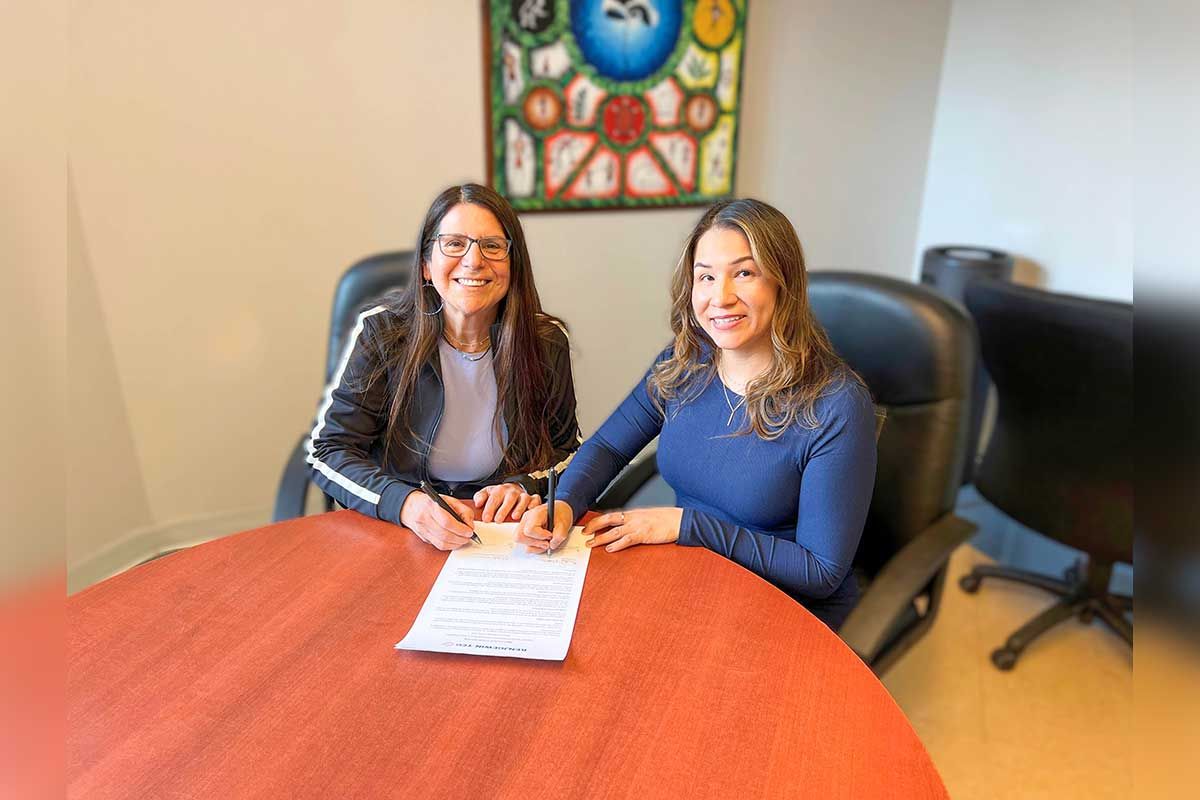
Dr. Amy Shawanda, director of research at Kenjgewin Teg and Dr. Lorrilee McGregor, chair of the Manitoulin Anishinaabek Research Review Committee (MARRC), sign a memorandum of understanding on Friday, May 22, between Kenjgewin Teg and MARRC, formalizing a relationship grounded in the Seven Grandfather Teachings and Minn-Bimadiziwin. The agreement reflects a shared commitment to honouring connection that already exists, carried by the land, the language and the people of Mnidoo Mnising long before it was written down, and strengthen Indigenous-led governance moving forward.
Dr. Amy Shawanda, director of research at Kenjgewin Teg and Dr. Lorrilee McGregor, chair of the Manitoulin Anishinaabek Research Review Committee (MARRC), sign a memorandum of understanding on Friday, May 22, between Kenjgewin Teg and MARRC, formalizing a relationship grounded in the Seven Grandfather Teachings and Minn-Bimadiziwin. The agreement reflects a shared commitment to honouring connection that already exists, carried by the land, the language and the people of Mnidoo Mnising long before it was written down, and strengthen Indigenous-led governance moving forward.
M鈥機HIGEENG鈥擪enjgewin Teg is honoured to announced that the Manitoulin Anishinaabek Research Review Committee (MARRC) will officially become part of Kenjgewin Teg, strengthening Indigenous-led research ethics, community-based research leadership and culturally grounded research practices across Mnidoo Mnising.
鈥淪upporting and growing community-based research leadership, in the form of a Mnidoo Mnising research ethics body, is very easy for Kenjgewin Teg to support,鈥� shared Kenjgewin Teg President Dr. Beverley Roy. 鈥淎s we build our own vision for Anishinabek research, led by Kenjgewin Teg鈥檚 new Director of Research Dr. Amy Shawanda, we are both honoured and humbled that the decades of good work by MARRC and Noojmowin Teg Health Centre are now entrusted to us to continue.鈥�
The origins of MARRC date back to March 2001, when Noojmowin Teg Health Access Centre hosted a community-based health research conference on Manitoulin Island. The gathering provided a forum for community members, elders, health care workers and researchers to share experiences with health research and discuss what ethical research should look like from a 91成人导航s perspective. Participants collectively developed a vision for health research grounded in respect, cultural safety and community priorities.
Advertisement
The committee was subsequently established through collaboration between Noojmowin Teg Health Centre, Mnaamodzawin Health Services, M鈥機higeeng Health Services, Wikwemikong Health Centre and Kenjgewin Teg. Working in consultation with local leadership, elders, community members and researchers, the committee developed the Guidelines for Ethical Aboriginal Research (GEAR).
The GEAR framework continues to serve as a community-based screening tool to support decision-making about research ethics. It guides communities in determining whether proposed research respects Anishinaabe customs, culture, and values, and whether it aligns with the vision for culturally appropriate research on Manitoulin Island.
鈥淥ver the past 25 years, the approach to research on Mnidoo Mnising has evolved with 91成人导航s asserting research sovereignty,鈥� reflected Dr. Lorrilee McGregor, chair of MARRC. 鈥淢y hope is that we鈥檝e moved beyond the era of unethical practices, harmful portrayals, and data theft. With the support of Noojmowin Teg Health Centre and a dedicated team of volunteers, MARRC has helped reshape the research landscape by applying Anishinabek ethics guidelines to research proposals. The shift to Kenjgewin Teg aligns with its new research focus, ensuring the momentum built over the years continues.鈥�
MARRC鈥檚 ethics review process is grounded in both local indigenous knowledge systems and national research standards, including alignment with the Tri-Council Policy Statement on ethical research conduct. This dual approach ensures that research involving Indigenous communities is held to rigorous ethical standards while also reflecting Indigenous worldviews and community expectations.
As a service to 91成人导航s communities and Indigenous organizations, MARRC reviews research proposals and provides recommendations to researchers and community partners to support informed decision-making and ethical research planning. Researchers are required to submit a completed ethics application and supporting documentation, which is then reviewed by a sub-committee guided by local Indigenous ethics and research principles. Review outcomes are communicated back to researchers and community partners, typically within an established review timeline.
In 2023, Kenjgewin Teg received formal institutional eligibility from the Social Sciences and Humanities Research Council (SSHRC), marking an important milestone in its expanding role in Indigenous post-secondary education and research leadership. As one of Ontario鈥檚 Indigenous Institutes, Kenjgewin Teg continues to advance research grounded in Anishinabek knowledge systems, language revitalization and community wellness.
鈥淲hen two Anishnaabe grounded leadership circles come together to govern research on our own terms, we are naming what has always been ours; the responsibility to govern knowledge about ourselves, on our own land, by our own teachings,鈥� said Dr. Amy Shawanda. 鈥淢nidoo Mnising is where this work lives, and today we walk together to support research in our communities. This (memorandum of understanding) honours that lineage and protects the work for the seasons and generations still to come.鈥�
Kenjgewin Teg extends gratitude to the many elders, knowledge holders, leaders, and community partners whose vision and collaboration helped establish and sustain MARRC over the past two decades.
Through this transition, Kenjgewin Teg remains committed to ensuring that Indigenous research continues to be guided by respect, reciprocity, cultural safety and the priorities of Anishinabek communities for generations to come.
Share this article
The link has been copied!
Members Discussion
Your link has expired. Please request a new one.
Your link has expired. Please request a new one.
Your link has expired. Please request a new one.
Great! You've successfully signed up.
Great! You've successfully signed up.
Welcome back! You've successfully signed in.
Success! You now have access to additional content.